Trends vs labs
Wearables versus the lab: what each one is for
Omid Mirzaei · 2026-08-15 · 8 min
A strap on the wrist is not a metabolic cart. Use wearables for direction over days. Use a lab when you need a number that has to be true on that day.
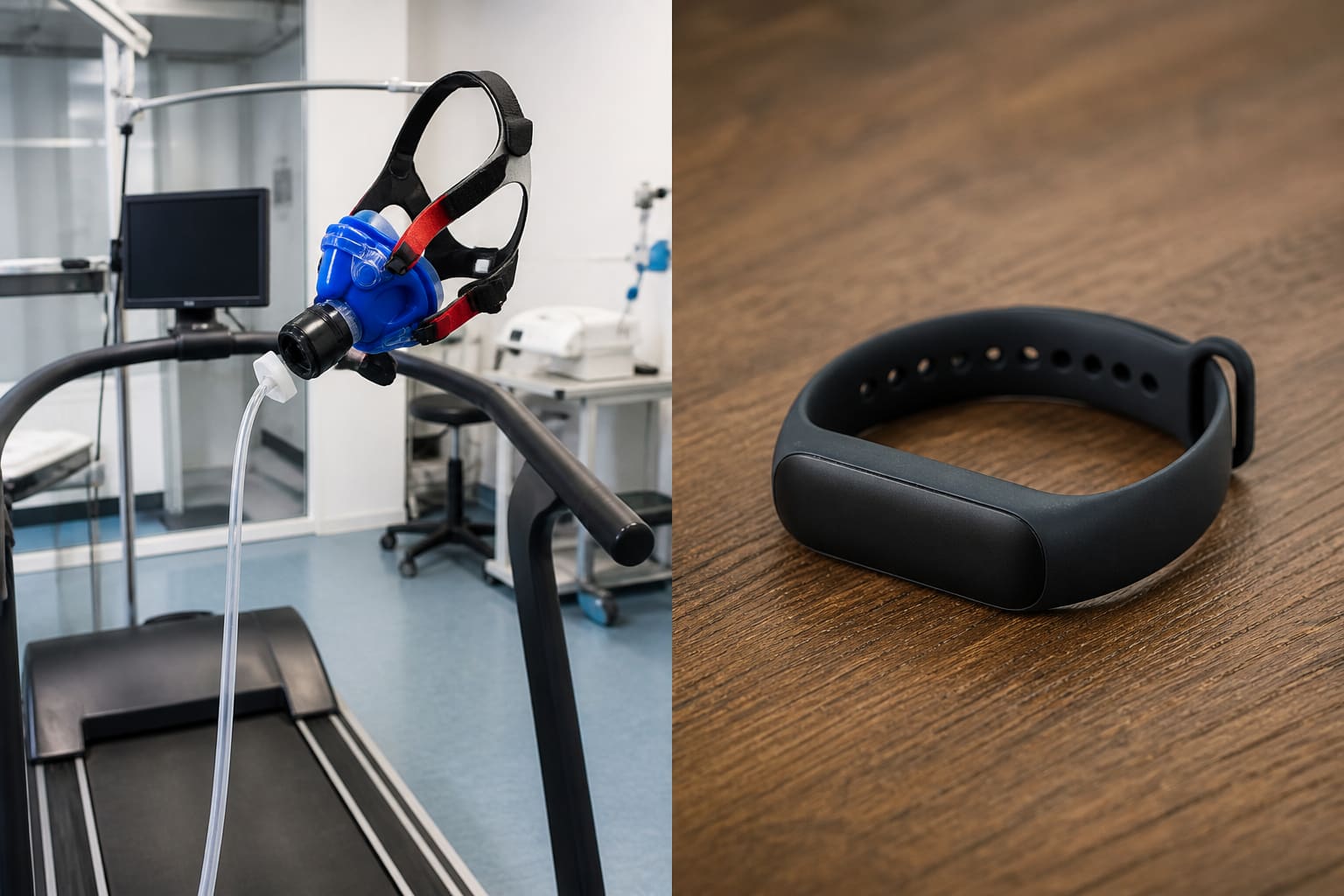
Two tools, two jobs
Hybrid athletes collect numbers. Resting heart rate. Recovery scores. A VO2max estimate that appeared in an app overnight. The mistake is treating every number as the same kind of truth. A wearable is built for repetition. A lab is built for a calibrated snapshot.
You wear a band every night. You visit a lab once or twice a year, if that. Those cadences decide the job. Nightly data is for trends: is this week heavier than last month, is sleep drifting, is overnight heart rate climbing while training load stays high. A lab day is for quantities that should not be guessed from optical sensors: maximal oxygen uptake, lactate or ventilatory thresholds, and body composition done with a method you can name.
WHOOP describes how it estimates overnight heart rate and heart rate variability from optical pulse (WHOOP, 2024). That is a consumer physiology pipeline. It is not a clinic. Keep the jobs separate and both tools get more useful.
Overnight cardiac trends are the strong claim
Miller, Sargent, and Roach compared six wearables, including WHOOP, against electrocardiography and polysomnography in healthy adults. Overnight heart rate and heart rate variability from WHOOP tracked closer to ECG than many people assume when they hear "optical sensor." That is the strongest part of the consumer story: the quiet hours, when you are still, and the device can watch pulse-to-pulse intervals without a race or a kettlebell swinging the strap (Miller, 2022).
That finding is why coaches look at rolling HRV and resting heart rate rather than a single morning panic. A week of overnight data can show a direction. One noisy night cannot. Bellenger and colleagues reported typical day-to-day variability of WHOOP-derived HRV in Olympic water polo athletes. Athletes already bounce. Your band will bounce with them (Bellenger, 2022).
Miller also put four-stage sleep staging against polysomnography, the overnight gold standard of electrodes and scored epochs. Agreement was weaker than for heart rate and HRV. Use total sleep time and a consistent bedtime as coaching inputs. Treat stage pie charts as illustrations. Panchawagh and colleagues reviewed WHOOP across health, wellness, and performance studies. Accuracy is not uniform across every metric the marketing screen can display. Overnight cardiac trends are a better question than how many minutes of deep sleep the firmware thinks you bought (Panchawagh, 2024).
When the lab still wins
VO2max from a graded test with expired gas is still the reference for aerobic power. Wrist estimates are convenient. They are not a substitute when you are setting training zones for a block you care about, or when you want to know whether a winter of easy aerobic work actually moved the ceiling.
Thresholds are the same story. A lab or a well-run field protocol with known conditions can place lactate or ventilatory turn points. An app that invents a threshold from last week's easy runs is doing pattern matching, not physiology. Body composition follows the same split. A DEXA or another named laboratory method is a snapshot. A scale trend is a trend. Do not argue with the snapshot using the trend, or the reverse.
Biosensing plus machine learning can support coaching when the model is trained on the right signals and the human still decides (Biosensors, 2026). Let algorithms summarize the cheap, frequent data. Pay for the expensive, infrequent data when the decision is expensive too.
Use both without mixing them up
A practical split looks like this. Wear the band every night. Review weekly means, not daily drama. Recheck VO2max, thresholds, and composition when a season turns or when the training question is large enough to justify the appointment. If the wearable and the lab disagree, I believe the lab for the snapshot and the wearable for the slope after that day.
Do not let a green recovery score talk you into ignoring pain, dizziness, or a collapse in performance you cannot explain. Do not let a red score cancel a well-planned easy run that would have helped. Scores are inputs. They are not coaches and they are not physicians. Wearables are not medical devices in the sense that they replace a physician, a sleep clinic, or a cardiac workup. Chest pain, unexplained fainting, disordered breathing at night, and sudden drops in exercise capacity need a clinician, not a tighter strap.
Takeaways
- WHOOP overnight heart rate and HRV compared reasonably with ECG in healthy adults; four-stage sleep staging did not (Miller, 2022).
- Day-to-day HRV on a wearable is noisy even in elite athletes: coach from weeks, not one night (Bellenger, 2022).
- Use labs for VO2max, thresholds, and named body-composition methods; use wearables for slopes over time.
References
- Miller DJ, Sargent C, Roach GD (2022). A Validation of Six Wearable Devices for Estimating Sleep, Heart Rate and Heart Rate Variability in Healthy Adults. Sensors. doi:10.3390/s22166317
- Panchawagh S, et al. (2024). Accuracy, Utility and Applicability of the WHOOP Wearable Monitoring Device in Health, Wellness and Performance: a systematic review. medRxiv. doi:10.1101/2024.01.04.24300784
- Bellenger CR, Miller D, Halson SL, Roach GD, Sargent C (2022). Evaluating the Typical Day-to-Day Variability of WHOOP-Derived Heart Rate Variability in Olympic Water Polo Athletes. Sensors. doi:10.3390/s22186723
- Various authors (2026). Wearable Biosensing and Machine Learning for Data-Driven Training and Coaching Support. Biosensors. doi:10.3390/bios16020097
- WHOOP (2024). How WHOOP measures heart rate and heart rate variability. WHOOP The Locker. Source